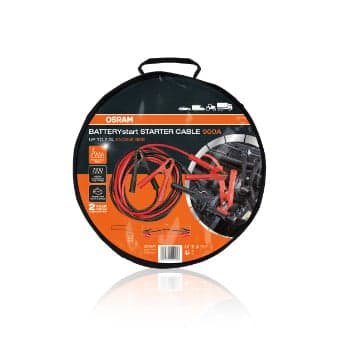
ams-OSRAMSTARTER CABLE 150AArt. OSC060£18.99
OEM & aftermarket jumper cables from top brands — compare prices, check fitment, order with free delivery



Shop 27 jumper cables from 4 trusted brands including ams-OSRAM, KS TOOLS, HELLA. Compare prices, check vehicle compatibility, and get free delivery on orders over £50.
Jump leads (booster cables) allow a vehicle with a flat battery to be started by borrowing cranking current from a second vehicle with a good battery. They are an essential piece of emergency kit for any car owner, particularly in winter when cold temperatures reduce battery capacity and increase the current required to start a cold engine. Choosing the right jump leads means selecting adequate cable cross-sectional area, sufficient clamp quality, and enough cable length to allow two vehicles to be positioned safely.
Cable cross-section is the most important specification. Thinner cables have higher resistance and limit the current available for cranking. For a general-purpose set suitable for most passenger cars, 600 A rated cables with a cross-section of at least 16 mm² (4 AWG) are the minimum recommended. For diesel SUVs and larger engines, choose 800–1000 A rated cables with 25 mm² (2 AWG) cable.
Connecting jump leads in the wrong order can damage both vehicles' electrical systems and, in extreme cases, cause a battery to spark and vent hydrogen gas. Always follow the correct sequence: connect positive to positive on both batteries, then connect the negative of the good battery to an unpainted earthing point on the engine block or chassis of the flat vehicle — not directly to the flat battery's negative terminal. This last connection is the one that sparks, and keeping it away from the battery reduces ignition risk.
A portable lithium jump-start power pack does not require a second vehicle — it is a compact battery unit that clips directly to the flat battery's terminals and provides enough cranking current to start most passenger car engines. Modern lithium packs are compact enough to fit in a glovebox and can start petrol engines up to 3.0 litres multiple times on a single charge. Their limitation is reduced performance in very cold conditions and finite stored charge.